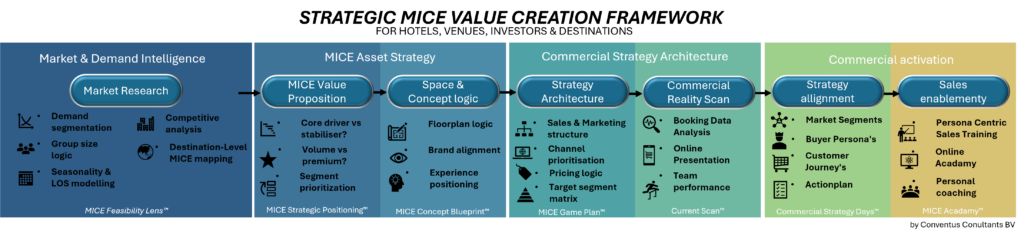
MICE Commercial Strategy Architecture
Even the strongest venue concept only creates value when supported by a coherent commercial strategy. Many organisations approach meetings and events opportunistically rather than through a structured commercial architecture.
Conventus helps venues, hotel groups and investors design the commercial foundation that allows the MICE strategy to perform. This includes defining target segments, structuring the sales organisation, designing pricing logic and establishing the right commercial priorities.
The result is a commercial architecture that aligns demand, positioning and sales execution.
What we design
→ Target segment matrix
Defining which market segments are strategically prioritized.
→ Positioning and commercial narrative
Translating the venue concept into a clear market story.
→ Sales and marketing structure
Designing roles, responsibilities and focus within the commercial team.
→ Pricing and value logic
Developing pricing frameworks that reflect positioning and demand patterns.
→ Channel prioritisation
Defining how direct sales, intermediaries and digital platforms should be used.
→ KPI framework
Establishing the metrics that guide commercial decision making.
Key strategic questions
→ Which market segments should the venue actively pursue?
→ How should the meetings product be positioned within the broader market?
→ What pricing logic supports the desired positioning and demand mix?
→ How should the sales organisation be structured to capture demand?
→ Which distribution channels generate the strongest opportunities?
→ How should commercial performance be measured?
Strategic outcome
A clear commercial architecture ensures that strategy is consistently translated into daily commercial decisions. By aligning segments, pricing, channels and sales focus, organisations can move from reactive booking management to proactive market development.
This commercial foundation prepares the organisation for the final step in the Conventus MICE Strategy Model: Commercial Activation.