Building stronger destinations through the meetings economy.
MICE Strategy for Destinations & Convention Bureaus
The meetings economy plays an important role in the development of successful destinations. Conferences, corporate meetings and association events bring international visitors, stimulate knowledge exchange and create year-round economic impact.
Cities and regions that take the meetings industry seriously often build dedicated destination organisations such as Convention Bureaus or Destination Marketing Organisations (DMOs). These organisations help structure the local meetings ecosystem and position the destination in the international meetings market.
Conventus supports destinations, municipalities and industry partners in developing effective strategies for the meetings economy and in designing or improving DMO structures.
Why the meetings economy matters for destinations
Meetings and conferences contribute far beyond hotel occupancy. They generate economic activity across the entire destination and strengthen the long-term profile of a city.
For many destinations, the meetings economy becomes an important pillar within their broader visitor economy strategy.
International visitor spending
Off-season tourism demand
Knowledge exchange and innovation
Stronger international positioning
Growth of local hospitality and event infrastructure
Lorem ipsum dolor sit amet, consectetur adipiscing elit
What we analyse
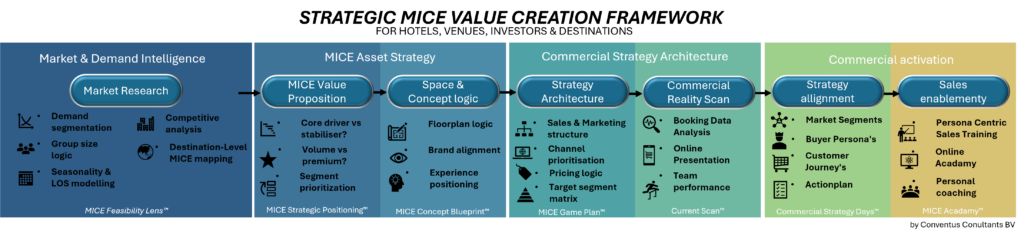
When working with destinations, we analyse the full ecosystem of the meetings economy
→ Destination attractiveness for meetings and conference
Understanding the different segments within the meetings market, from corporate meetings to association conferences and incentive events.
→ Existing venue infrastructure and meeting capacity
Analysing how group sizes, meeting frequency and length of stay influence venue utilisation and revenue potential.
→ International feeder markets
Mapping competing venues, hotel meeting facilities and convention centres to understand positioning and market gaps.
→ Competitive positioning versus other destinations
Identifying the key geographic markets and industries that generate meeting demand.
→ Industry clusters and knowledge sectors
Understanding how far in advance meetings are booked and how this impacts commercial strategy.
→ The role and structure of the DMO or convention bureau
Evaluating accessibility, infrastructure, accommodation capacity and the unique benefits that make a destination attractive for meetings and conferences.
What we design
Based on this analysis we support destinations with the design of a clear and effective meetings strategy.
The goal is to create a structure in which venues, hotels, municipalities and industry partners work together to grow the meetings economy.
Strategic outcome
A clear destination strategy strengthens the entire meetings ecosystem. With the right positioning, governance structure and market focus, destinations can attract more international meetings while creating sustainable economic impact for the region.