
Hotel Positioning: Who Are Your Real Competitors?
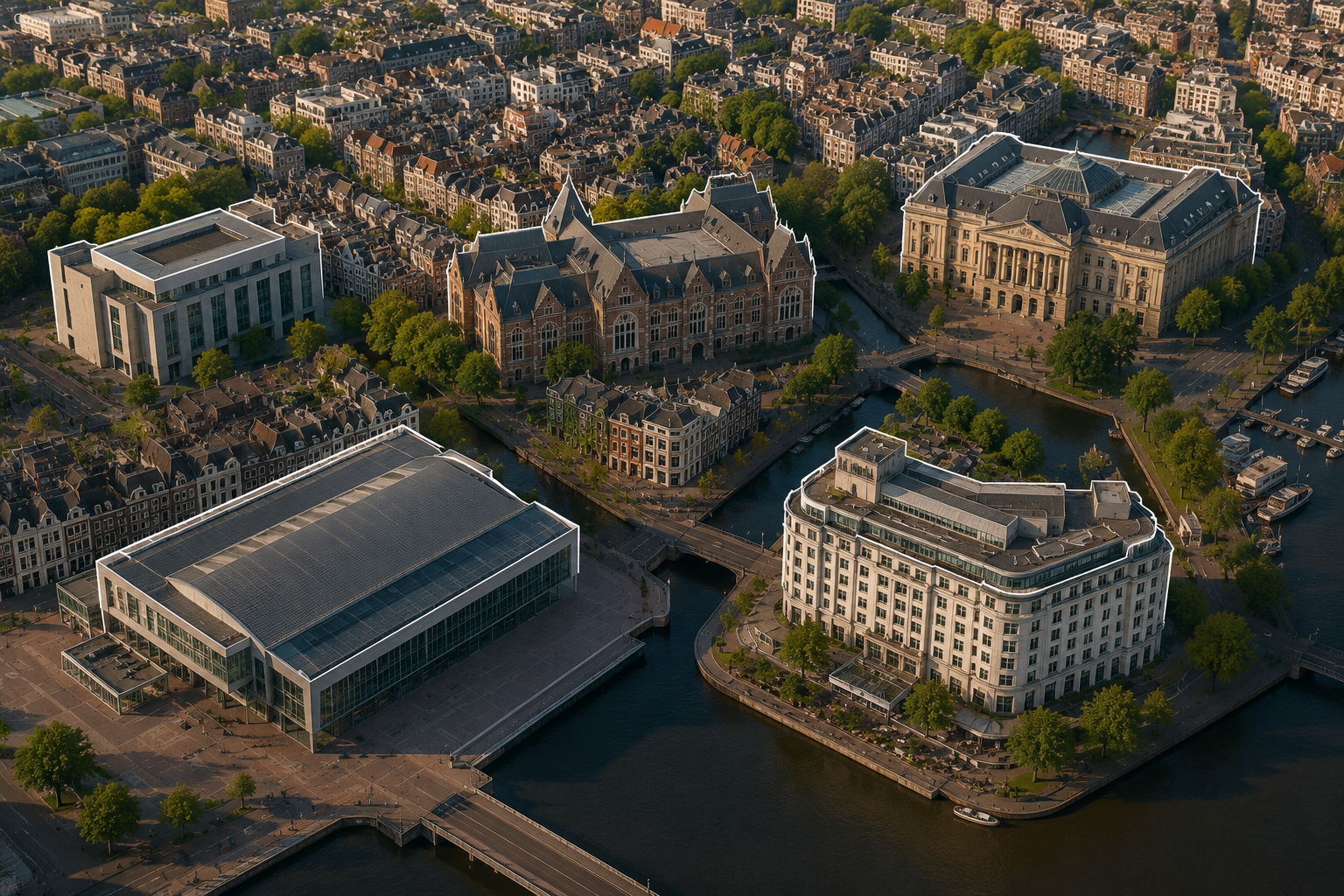
Hotel and venues rarely compete within fixed categories. Depending on the event, a convention centre, hotel or historic venue may all end up on the same shortlist. Understanding that dynamic changes how we should think about hotel or venue positioning.
Ask almost any venue who their competitors are, and the answer usually comes without hesitation.
A convention centre compares itself with other convention centres.
A hotel benchmarks against hotels.
A historic venue looks at other heritage venues.
It seems logical. But is that how event organisers actually make decisions?
Recent market research we conducted among international meeting planners suggests otherwise. One of the clearest findings was that there is no fixed competitive set in the meetings industry. The venues that make a shortlist depend entirely on the context of the event.
In other words, competition in the MICE market is not structural. It is situational.
Organisers don’t buy venues
This may sound obvious, but it fundamentally changes how we should think about positioning. Organisers rarely start by asking, “Which venue should we book?”
Instead, they ask:
“What does this event need to achieve?”
Only then do venues enter the conversation. That means a convention centre may compete with a luxury hotel. A boutique venue may compete with a museum. A conference hotel may suddenly compete with an iconic city-centre landmark.
Not because they look alike. Because they solve the same problem.
The Industry Often Defines Competition Too Narrowly
Many positioning exercises begin with a list of direct competitors. It feels like the logical starting point. But what if that list is already incomplete?
If organisers build their shortlist around the objectives of an event rather than the category of a venue, then competition becomes fluid. Every event creates a different competitive landscape.
The question is therefore not: “Who looks like us?”
But rather: “Who else could solve the client’s challenge?”
That is a very different discussion.
What Clients Actually Buy
Clients rarely buy square metres.
- They buy accessibility.
- They buy operational certainty.
- They buy flexibility.
- They buy atmosphere.
- They buy technical capability.
- They buy destination appeal.
- And above all, they buy the confidence and trust that their event will achieve its objectives.
Once you start looking at venue selection through that lens, it becomes much easier to understand why seemingly unrelated venues end up competing for exactly the same business.
Positioning Is About Relevance, Not Category
This observation led us to rethink how venues should be positioned. Most positioning models classify venues by what they are. We wanted to understand why they are chosen.
That distinction became the foundation of the Conventus Venue Positioning Matrix.
Rather than categorising venues by building type, ownership or capacity, the model looks at two strategic dimensions that consistently influence venue selection.
- The first is the balance between functional efficiency and experience-led value.
- The second is the ability to deliver increasingly complex events.
Together, these dimensions reveal something that traditional benchmarking often overlooks: venues with completely different products can occupy exactly the same competitive space.
There Is No Value in an Empty Position
One of the first questions our clients often ask after seeing the matrix is:
“Where is the white space?”
It is an understandable question, but perhaps the wrong one. An empty position is not automatically an opportunity. It may simply reflect that market demand is limited. Or that the position requires a level of infrastructure, operational capability or destination appeal that cannot realistically be achieved.
After all, positioning is not just about ambition. It is constrained by the asset itself. A modern business venue rarely becomes an iconic destination overnight, just as a venue designed around small meeting rooms is unlikely to evolve into a large-scale congress venue without fundamental investment.
The question is therefore not where a venue would like to be positioned, but which position it can credibly occupy, given its market, its physical characteristics and the level of investment that makes commercial sense.
Successful positioning is not about occupying an empty space.
It is about occupying a credible one.
A Different Starting Point
Perhaps the industry has been asking the wrong question.
Instead of asking:
“Who are our competitors?”
We should first ask:
“In which buying situations do we want to be considered?”
Once that question is answered, the competitive landscape becomes much clearer.
And more often than not, it looks very different from the one we started with.

No responses yet